Entry Level
- Famed Vallejo Street pedestrian steps, designed by Willis
Polk, lead to an elegant front door of iron and glass
- Large reception
area with marble floors, leaded glass windows and cushioned window seats
lead up to the grand marble stairway and living room
- Powder room
- Double
doors open to a wide hall way leading to the media room
- Game room with
leaded glass windows overlooks the city and gardens
- Beautiful glass roof
conservatory has stairs up to a “secret garden” and stairs down
to the garage
- Spacious, view guest suite
- Laundry center & storage
Main Level
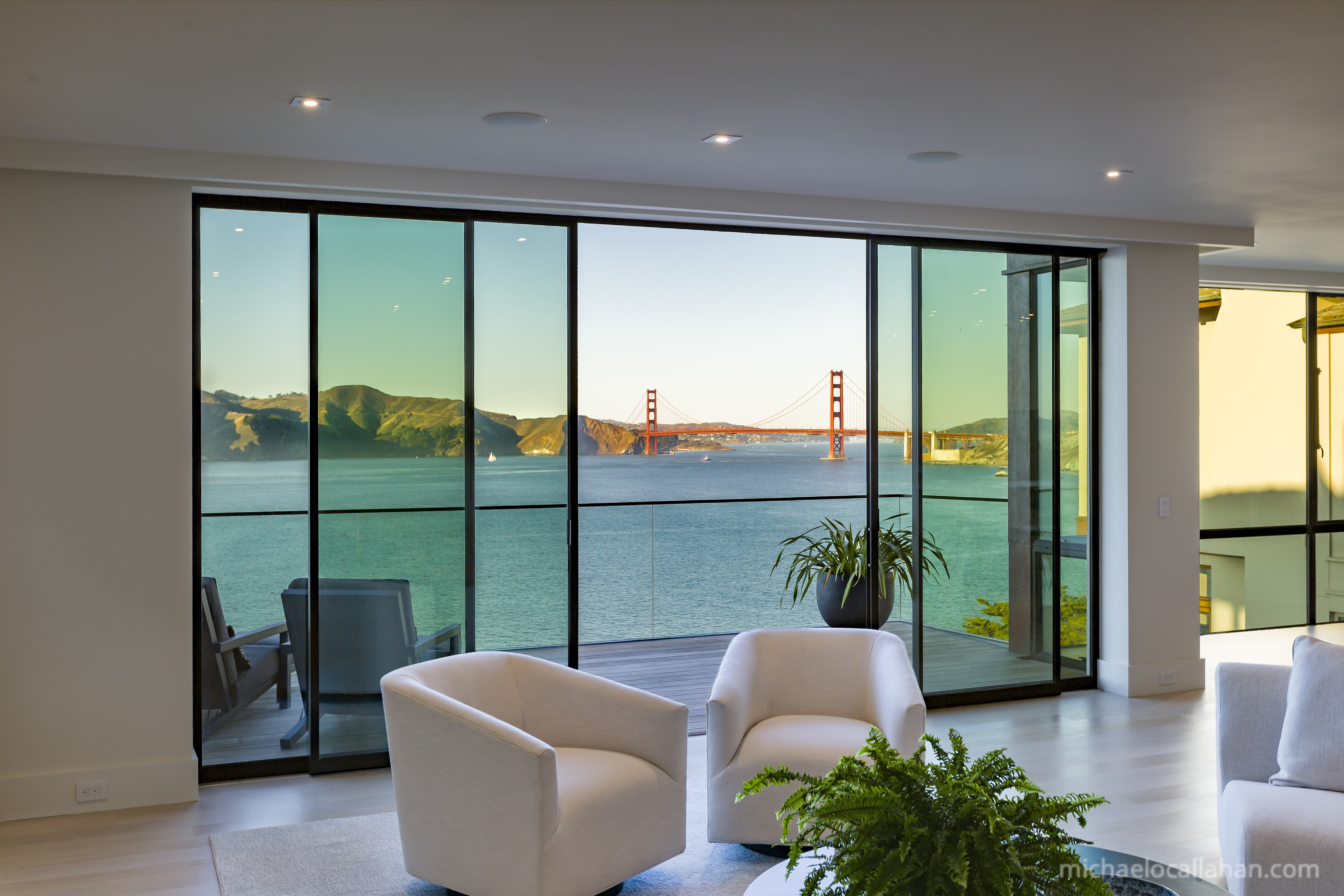
- Light filled marble staircase opens to the painted wood-paneled
grand ballroom/living room with soaring windows of leaded glass revealing
the city and bay, a massive fireplace, and a balcony with balustrades
- To
the west are French doors opening to a lovely sheltered terrace that expands
the entertaining area or is available for private enjoyment
- Elegant
formal dining room enjoys the open feel of the great room
- Interior
French doors combine the formal and informal living spaces
- World class
east-facing view kitchen has granite counters, hardwood floors, bleached
wood cabinetry. Appliances include: Sub Zero refrigerator, wine refrigerator,
U-Line ice maker, Thermador Professional Stove, with free-standing Thermador
hood, muted sky lights, built- in Sharp Carousel microwave and convection
oven., build -in warming drawer, double stainless sinks looking out to the
Bay Bridge, plus a separate stainless sink, two disposers, Braun trash compactor,
two Bosch dishwashers
- French doors open out to a sensational south-east terrace
overlooking the bay and the pyramid, and a tall tree visited by the famous
Parrots of Telegraph Hill
- A half bath is located off of the kitchen
Master Level
- Dramatic open staircase continues past the mezzanine
library/office to the light-filled winding gallery hallway overlooking
the lower levels
- Private home office (or sixth bedroom) with its own bathroom
enjoys spectacular views and south-east light
- Huge master bedroom with
a wood burning fireplace has views to the East and North
- Walk-in closet
accommodates a large wardrobe
- Elegant marble master bathroom opens
to a view terrace and boasts double vanities, a large shower, deep tub,
and a private toilet and bidet
Top Level
- Spectacular view sitting area/gallery hallway
- Three
bedrooms
- Three bathrooms
Fascinating San Francisco History
Russian Hill - Background
The Summit of Russian,
Hill, rising to 360' above sea level, is unique in that its geography, historically
and currently, provides not only a commanding view of the bay and near by urban
areas, but also an isolated, park like presence in the city.
In his book, 1 “From
Russian Hill: The Summit 1853-1906” William Kostura explain “Members
of the building trades established a community here in 1853. By the 1890s the
Summit was notable for its artistic groups and social life.” Kostura
quotes Emma Frances Dawson describing in 1896 a mystical sensation from her
book “A Gracious Visitation”
“I live in a region of remote
sounds. On Russian Hill I looked down as from a balloon; all there is of the
stir of the city."
1As is in the past, Vallejo
and Green streets turn into “streets
of steps” between Taylor and Jones. The Vallejo Street architectural
pathway, formerly a goat path, was designed by Willis Polk before the quake
of ’06 but was not completed until 8 years later. From the curved, balustraded
carriage turnaround at the mid-block on Vallejo there descends easterly a stairway,
also balustraded, which zigzags through foliage and terminates at Taylor Street,
just opposite Coolbrith Park. Everything about the summit is pedestrian oriented...
to distinguish it from the surrounding city. Tall retaining walls on Broadway
and Taylor streets define the boundaries of the summit, setting it apart physically
and giving it a fortress-like aspect.”
In 1890s the Eastern Slope of Russian hill had become more urbanized and
was settled by Italian residents. The Vallejo Crest remained unique, but was
1“filtering
down to less wealthy clientele. A sort of faded gentility still clung to the
best of the early elite districts. Houses on Russian Hill considered romantic
due to their connection with the city’s earlier days. People on the crest
had a common distaste for Victorian architecture. The group that remained,
including Willis Polk, reflected newer eastern trends and that of old buildings
in Europe”, an example being his house at 1019 Vallejo “with shingled
exterior resembled late-medieval urban houses in Brittany, France.” Bohemia
followed Willis Polk into his family home.From 1890 through the 1930s, Russian
Hill was both the home and meeting place of the Bohemians; architects, writers,
and others who met frequently to engage in discussion, collaborate and party.
House
Construction - The Hanford House: Houghton, Sawyer Architect
1In 1905, within
a few months of each other, Livingston Jenks and Robert G. Hanford began construction
of their residences at the northwest and southwest corners of Vallejo and Taylor
streets “Simultaneously the stucco mansions rose up from the sandstone
of Russian Hill, Jenks’ residence directly across the street from Hanford’s,
and one could easily imagine that they regarded each other, vying for supremacy
as the largest in the neighborhood. From the street the two houses looked like
fortresses.
2“According to the “National Register of Historic Places
Inventory – Nomination Form” “Architect Houghton Sawyer was
known for residential work, particularly the apartments at 1001 California
and 901 Powell, a house at 2518 Buchanan, and a major addition at 2220 Sacramento.”
1"The
original owner of 1001 Vallejo, Robert G. Hanford, was a businessman and mining
promoter who, like Horatio Livermore, operated on a larger scale than most
of his contemporaries even dreamed of. He made a fortune in 1901-02 when he
acquired control of several large street railways in San Francisco and, with
Tirey L. Ford, engineered their sale to an eastern syndicate for a vastly inflated
sum. This consolidation of the Market Street Railway, Sutter Street Railway,
and an interurban line as the United Railroads was called the biggest cash
deal in the history of the nation. At the same time Hanford was active as a
miner, dredging huge areas of the American and Feather rivers for gold deposits.
He would later become active in electrical power and real estate."
1"Mrs.
Hanford was a daughter of the founder of the Guittard Company, importers and
dealers in tea, spices, coffee, soda, flavoring extracts, and especially chocolate.
As Gabrielle Guittard Cavalsky, she first met Hanford at the Del Monte golf
course, where she was playing a round. … It was a picture that Hanford
fell for utterly. Unfortunately, before they could marry, they each had to
obtain a divorce. This they did in 1905. In preparation, Hanford informed his
current wife by letter “a man feels the grand passion but once in a lifetime,
and I have it for Mrs. Cavalsky.” Shortly afterward, Gabrielle obtained
her divorce from dentist Valdamar Cavalsky."Although there are several
legends of the origin of the house, Kostura writes: 1“Now
Hanford could build a mansion for his new bride on the Summit of Russian Hill.
The most notable feature of the house may have been designed with her in mind.
It was a huge wood paneled ballroom at one end of which was an elevated balcony.
According to a later resident, the new Mrs. Hanford was an accomplished vocalist,
and she was to sing from this balcony accompanied by musicians below."
1"The
Robert G. Hanford house at 1001 Vallejo was begun a few months before the Jenks
house ,and was still under construction when the latter was finished. Three
stories in height, with an attic and a large basement story, it was built to
the property line on both Taylor and Vallejo streets, looming ponderously over
passersby. Like the Jenks house, Hanford’s was finished in stucco. The
material had often been used as a smooth veneer for brick commercial and institutional
buildings in San Francisco during the 1850s and 1860s, but had virtually never
been used on residences until the 1890s, and rarely then. Its use on the Jenks
and Hanford houses in 1905-06 prefigured the stucco Mediterranean and pueblo
houses that Horatio and Norman Livermore would build on Russian Hill Place,
Florence Street and Jones Street in 1912-16."
1"Though built
with similar materials, the two mansions looked quite different. Jenk’s
residence had a southern European feeling while Hanford’s had a more
northern European look. The oriel windows were Tudorish, and crenellated at
the top with molded supports below. The squared –off gable facing Vallejo
similarly conveyed a Tudor or medieval feeling. The windows were everywhere
composed of many lights divided by leaded muntins, and made with fine craftsmanship.
The entrance, which faced Vallejo Street and was reached by the goat path,
was somewhat classical in style. There was a conservatory with a separate entrance
down the hill on Taylor Street, where the north half of the Ranlett house had
once stood. Its architect was Houghton Sawyer, who was then at the beginning
of his career as a designer of fine residences and luxury apartment buildings." The
San Francisco Water Department had a record of R.G. Hanford owner 1/2/06.
1“The
Hanford marriage would prove to be very short-lived, but no one knew that as
the house neared completion and the couple prepared to move in. Scaffolding
was up and finishing touches were being made to the exterior as the calendar
page turned to April 18th.”
“The Vallejo Street Improvements (1914-1915) “announce
and enforce the separation of the district from the outside world, provide
its only interior auto access, and contribute to its scenic greenery and beauty.
They were one of Polk’s very few realized projects for city beautification.
They were commissioned, not by the City which owned the land, but by the adjoining
property owners, organized together by Polk’s patron, H.P. Livermore.”
The
Mysterious Years
Records indicate a transfer from R.G. Hanford to Clarence Grange – D.O.K.
4/13/15 and a subsequent transfer from Clarence Francis Grange to M. O’Connell
8/30/19.
Bohemian Salon
3According to Margaret Parton, in her book “Laughter
on the Hill, A San Francisco Interlude”, the house remained empty for several
years. "Then one day Satu Kelley; a Eurasian actor, drifted into town,
spied the house, and conceived a great idea."
"Mr. Kelly rented the
house from whatever corporation than had it in tow and sent out embossed invitations
to one hundred leading San Francisco clubwomen. For only $5 an evening, he
told them, they could listen to him read Ibsen in the majestic setting of the
House of the Grand Passion. They were delighted at the suggestion, and the
first evening scores of them flocked up the stone stairways to get cultured.
What's more they bought season tickets in advance – only $50 for the
series."
"Satu didn’t disappoint them. The musty ballroom was
fitted with squeaking chairs which he had hired from a near-by undertaker,
and over the mantel, elaborately carved with gloomy symbols, flickered a tiny
alcohol lamp, throwing a wavering green shadow on (Satu’s) tuber-like
face. In one hand he held a long white candle which glowed on the blood-red
copy of Ibsen which he held in his other. The dowagers shivered with delight."
"All
in all, the first reading was a great success. Unfortunately, the next night
the ballroom mysteriously caught fire, and though it was only slightly damaged,
Mr. Kelly claimed that the setting for his readings had been spiritually destroyed
and he left town hurriedly, still in possession of advance subscription sales.”
The
Verdier Mansion – 1919 -1953
Records indicate a transfer on 12/19/19 – from
Charles s. C. Sullivan to Paul Verdier, and then subsequent transfers to other
members of the Verdier Family. When the property was sold in 1953, however,
the Referee’s Deed named Paul Verdier, Alexandriene Verdier, Wells Fargo
Bank & Union Trust Company, and Union Securities.
4"Dating from 1850
when Felix Verdier and his brother, Emile, prosperous French merchants, sailed
into San Francisco, not to mine gold, but to sell “baskets of champagne,
casks of rare wines and barrels of brandy, Persian shawls,...petticoats...laces
and silks”; the Verdier family, founders of the elegant store “Ville
de Paris” or The City of Paris” have brought the good life to San
Francisco. They represented “savoir faire.” Nora Leishman’s
article “The City of Paris”, printed in the Argonaut, stated that
Paul Verdier took over management of the store in 1904 and retained management
until shortly before his death in 1966. After the earthquake and fire of 1906,
he moved the store merchandise into the Hobart mansion on Van Ness, then to
Geary and Stockton. In 1918 the store was expanded, the beaux arts building
containing the famous circular interior and dome, designed by architects Arthur
Brown and John Bakewell, is retained by Neiman Marcus today. Paul Verdier was “the
most prominent leader of San Francisco’s French community. The French
government promoted him to Commander, highest rank in the Legion of Honor.
He served as Ambassador to the United States from Rumania to Monaco, was a
Captain in the State National Guard, and President of the California Palace
of the Legion of Honor. “The Argonaut article quoted Emile Drevoir on
Verdier and the Verdier Cellars: “He was fantastic…his whole heart
was in the project. He had wines nobody in the city had. He knew more about
wines than anybody I ever knew… Verdier fought to prevent the possible
reoccurrence of the ‘curse’ of Prohibition.”
There must have
some wonderful parties at 1001 Vallejo Street. At some point the Verdiers,
who had a ranch in Sonoma, moved from The Vallejo Crest and rented out the
property.
The Dream House/Opium Den
3According to Margaret Parton, whose family
moved into the house next door in the early 1920s, she "remembered looking
through bushes up to the bulk of what, in my fanciful childhood, I liked to
call the Dream House. …Perhaps it caught my attention because of the “flickering
blue and green lights, which used to appear and disappear against the blackened
window panes at night. They were like fireflies. …One night, however,
lights flared in the supposedly deserted mansion, and gunfire echoed down Taylor
Street. After that there were no more firefly lights. Years later I discovered
that government men, had traced certain well-known opium addicts to the house,
where ingenious smokers had discovered a subterranean tunnel leading from the
steep hillside into the subbasement. Equipped with Chinese mats, the tiny rooms
made perfect cubicles for the addicts to steal “furtively into the House
of the Grand Passion to roll their little brown pellets over the shimmering
blue flames of the alcohol lamps."
Artist’s Ball
Parton3 remembered
when one of the annual artist’s balls, was held in the great ballroom. “Every
Hill in San Francisco was represented by a contingent of artists, all dressed
according to some theme. Russian Hill, for instance, represented all the psychoses
recently exposed by the new god, Freud… Her favorite group was the
Telegraph Hill contingent that came as goats, the traditional animal of the
hill.”
Sally Stanford’s Brothel (late 1930s –1941)
According
to Herb Caen5: “Sally
Stanford the famous madam. She had a huge house up on Russian Hill which was
owned by the man who ran the City of Paris, a very proper fellow named Paul
Verdier. The Verdier mansion was leased by Madam Stanford. And her girls were
all like socialites, they were like Junior Leaguers. They had dusters and feather
boas and they wore corsages and they acted like ladies. It was even on the
Gray Line tour for a while! You could drop in if you were on the tour and meet
Sally’s girls.”
According to the Junior League files6 the
story goes, “At that time,
the house was frequented by men on the hill and was the scene of much drinking
and gambling, etc.. A dent in the front door was supposed to have been
made by police…. On the event of this particular event the police weren’t
raiding the joint, but merely wished to inform Mme. Stanford that the car of
one of her gentleman callers was on fire."
7"Mr. SF.com Heart of the
City," quotes Sally Stanford in her autobiography, The Lady of the
House, “I
decided to move to another house in just as deluxe a district and set up camp
where the neighbors had more to do than to peep through their draperies and
put a stopwatch on the visits of my guests. Besides, the roof had begun to
leak and there were complaints during the rainy season from those who didn’t
appreciate the sensuous delight of a trickle of water on a bare bottom.”
Inter-America House
6From the Junior League files; “After Mme. Stanford’s departure,
the house was rented to Mrs. K. Hope Hamilton for the sum of $175 a month in
order that she might establish an Inter-American House” (A marker on
the Vallejo Street Steps at Taylor commemorates this use of the building).
The purpose of the Inter-America House was to promote better understanding
between the Americas. It was to be open to these people for their entertainment
and comfort and to help them with any problems – like the International
Hospitality Center.
Junior Officers’ Club 1941-46
6"However, the
war (WWII) started before this could be done, so it became an Officer’s
club or retreat. Called Jr. Officers Movement, fifty five thousand men visited
the center between 1941 –1946. Anyone with rank of Ensign through Colonel
or Captain was welcome and their superiors were welcome, but enlisted men could
only provide music or other entertainment or help out in the kitchen. The late
John Fitzgerald Kennedy who visited the center 17 times, and had wanted to
give her a rather large donation to subsidize the operation. This could not
be done, however, as there was a policy that no serviceman could pay for anything,
nor could a contribution be accepted from him for the center. The center was
open three nights a week until midnight, and volunteers – ladies – helped
entertain the men. Married women could work, but were forbidden to dance. Mrs.
Hamilton has hundreds of pictures taken at these parties and delighted in pointing
out her pets; the most favorite of them all being Cora Wyman whose mother,
she says, started the San Francisco Junior League. Cora also apparently wrote
an article in our Spectator, April 1943, on the Inter-American House. Mrs.
Hamilton stressed that her volunteers were socialites! The center was run on
a shoestring - $16 a year from the carefully screened volunteers plus pledges
from wealthier people all over the city who wanted to remain nameless. Funds
were raised from card parties and such benefits. Mrs. Hamilton and her volunteers
and visitors cleared some land in back of the house and built a Barbeque pit
and area for parties. Various dealers through the city pledged meat for such
occasions. For this occasion, Blums donated a huge cake worth $275 and Podesta
donated spring flowers. The house has its own flag made by the center. The
center also had an ecclesiastical light or eternal flame that burned in a special
window and was visible from the bay to welcome sailors home, or to provide
a last good bye for many.
In January 1944, H.R.H Juliana of the Netherlands visited the center. Detailed
log of activities at the center is the property of Bancroft Library. The pictures
and letters Mrs. Hamilton has in her possession were to go to the Bancroft
library at her death."
Russian Tea Room
It appears that the conservatory
was occupied separately. According to the footnotes of William Kostura,
Jacues Schnier rented the conservatory first from Sally Stanford and then from
the owner, Paul Verdier, during the late 1930s-early 1040s.
In her book, Parton
recalls3, “Here I was having tea with Mr. Schnier, in his roofed-over
garden of the house of Grand Passion. The mansion itself had become some kind
of club. His apartment, however, was not conventional. The floor was tiled,
as it had been when the room was a garden, and the concrete walls were still
covered with flourishing vines. At one end was a flight of steps leading upwards
above a fountain, almost to the ceiling where the carved ends of the pergola
supports rested."
9Carol Ann Rogers recalled, "When we first moved
here, one of our neighbors next door who had lived here for 40 years remembers
that the greenhouse was a Russian Tea Room: and she and her husband used to
sit on their balcony and listen to the strolling violinists on nice evenings."
A
House Big Enough for a Man, His Mistress and Wife
According to lore recorded
by Junior League researchers, 6"Mrs. Hamilton was bodily evicted from
the house when Mr. Verdier decided to install his mistress in it. The mistress
was a music teacher of some sort and was quite fond of the house and insisted
on living in it. After a period of time had elapsed, she established a young
man on the upper floor. When Mr. Verdier got wind of this, he insisted on occupying
the lower floor! Mrs. Verdier got wind of all of this and arrived from Paris
to file for divorce. She also wanted the house or at least half of it, as was
her right under the community property laws, so it is my understanding that
the house was then auctioned and that it was at this time."
Sale to Catherine
Doliani
6"The story goes that Mrs. Hamilton loved the house and wanted
to buy it, but that she was out bid at an auction by that Catherine Doliani,
a very colorful character." Title records show a Referee’s Deed
recorded on January 13, 1953. 9Over the years she illegally divided it into
a myriad of units, doing most of the work herself. She looked like a “bag
lady, if you ever saw her on the street, but she owned what became millions
of dollars worth of real estate around the City, (She owned the house on the
Lyon Street steps that Dianne Feinstein just purchased). She became senile,
and her accountant and his partner began siphoning off the assets. One of them
eventually “married” her in Nevada. They were eventually found
out and sent to jail – the newspapers had a field day with the story."
Restoration to a Grand Home
On May 27, 1992, the property was sold to Dr. and
Mrs. Thomas Grotz. Dr. Grotz is a San Francisco orthopedist, and Lena restores
properties. They did an extensive renovation of the property, restoring the
mansion to its original grandeur while embellishing it to meet today’s
high-end standards, and adding to its structure. Shortly after completion,
they moved on to another project.
San Francisco Home for Newlywed Nobel Prize
Winner
In July of 1998 the home was purchased by Jan Blaustein and Myron Scholes
who had looked for quite some time to find a wonderful home in San Francisco
to begin their marriage. Although they would love to spend more time in the
Bay area with their children and grandchildren, they are bi-coastal splitting
time between New York and San Francisco. Jan Blaustein Scholes is a graduate
of Boalt Hall at U.C. Berkeley and General Counsel of a global investment bank
that requires her to travel to places far from San Francisco. Myron Scholes,
who was awarded the Nobel Prize in economics in 1997, is a retired chaired
professor at Stanford University and is co-managing partner of Oak Hill Platinum
Partners, a $2 billion hedge fund located in Rye Brook, NY. He too travels
around the world giving talks, participating in conferences and meeting investors,
etc. Although they loved their Vallejo home, a smaller one suits them much
better at this stage in their lives.
Their Vallejo Street Crest home has been
a wonderful place to entertain small or large groups of friends. And, with
large gatherings whether a group of over 150 associated with the Committee
of 100 Chinese American families, a similar size group for Stanford Hillel,
or smaller group to greet Sri Sri Ravi Sankar leader of the Art of Living Foundation
or a new Dean of Boalt Hall, the house has been filled with joy and enthusiasm.
With valet parking the movement from car up the stairs to the front door is
seamless, and with smaller parties nine cars can find their way into the garage
for those who can’t find a spot on the street. Towards the end of one
large party, the City of San Francisco gave the guests the treat of watching
a large fire-works display. The views at night are awe inspiring even when
having dinner alone. And, each year grandchildren and friends gather to watch
the Blue Angels fly right over the house in May during fleet week.
The Scholes
have gathered together a team of individuals who really love to tend to their
home. Professor Scholes always jokes that many strangers seem to be coming
and going while he is working in this study overlooking the Bay Bridge and
San Francisco, a study that is set perfectly for Feng Shui principles (as
is the rest of house), facing the east and the south and painted in dark green.
1001 Vallejo
Sources of Information
- “Russian Hill: The Summit 1853-1906, Volume
I of a Neighborhood History” by William Kostura. Aerie Publications
- United States Department of the Interior Heritage conservation and Recreation
Service: National Register of Historic Places Inventory – Nomination
Form
- “Laughter on the Hill, A San Francisco Interlude” by Margaret
Parton Published in 1945 by McGraw-
Hill Book company, Inc.
- The Argonaut: The City of Paris by Nora Leishman
-
SFGate.com: Herb Caen, “:A wide Open Town” KRON 6/17/99
- San
Francisco Public Library History Room File: Junior League of San Francisco
research notes for “Here Today”
- www.mistersf.com/notorious/:
Sally Stanford
- Personal antidotes of Carol Ann Rogers, Russian Hill Crest
resident
- From “Russian Hill Neighbors”